The ISO certification process for Sydney businesses has five stages: an initial consultation, a gap analysis, building your management system, running it and auditing yourself internally, and then passing an external audit by an accredited certification body. For a small or medium business that starts organised and has a clear owner for the project, the whole journey can take roughly three months. Larger or less-documented businesses should plan for longer.
Most Sydney businesses start this because someone else asked: a tender, a bigger customer, an insurer. If that’s you, this guide covers what ISO certification in Sydney involves, which standard to pick, what auditors check and how to choose help without taking on more than you need.
The ISO certification process, step by step
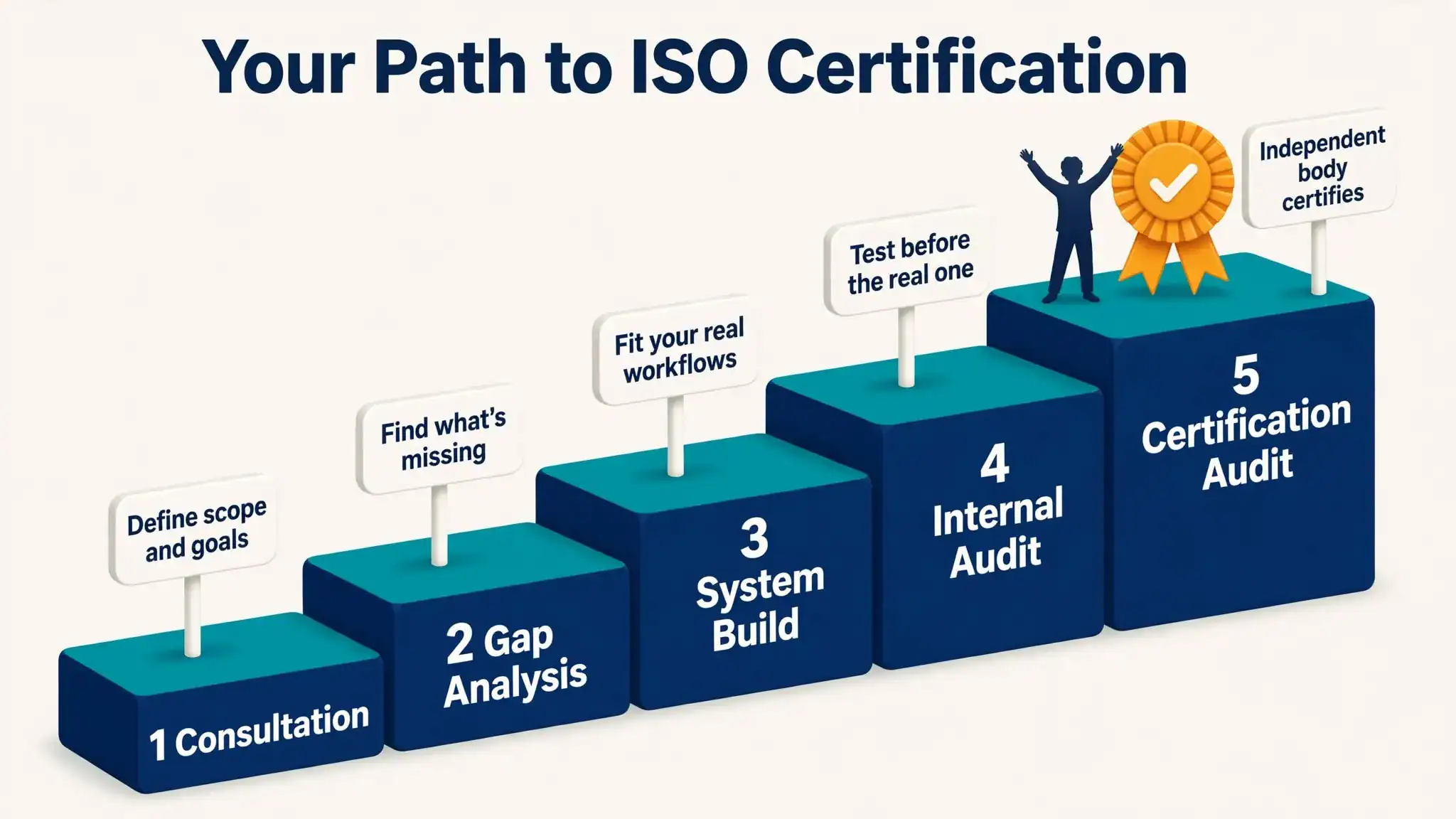
The standard doesn’t tell you how to run your business. It asks you to document how you already run it, check that it works, and fix what doesn’t. Most Sydney businesses move through these stages:
- Initial consultation. You define the standard you’re aiming for, your scope (which sites, services and teams are covered) and why you want certification. A tender requirement and a customer request lead to very different projects.
- Gap analysis. Your current processes, records and documents are compared against the standard’s requirements. The output is a plain list of what you already have and what’s missing.
- Management system development. The policies, procedures, forms and records the standard requires are written around your real workflows. Systems copied from a generic template tend to cause trouble later, because staff don’t recognise their own work in them.
- Implementation and internal audit. Your team uses the system for a period so there are real records to show. An internal audit then tests it before anyone external does.
- Certification audit. An independent certification body audits the system. In Australia, look for one accredited by JAS-ANZ, the binational body Australia and New Zealand set up under a 1991 treaty to confirm certification bodies are competent and impartial.
A good ISO consulting service in Sydney supports steps one to four and prepares you for five. The certificate itself always comes from the independent certification body.
How long does ISO certification take in Sydney and NSW?
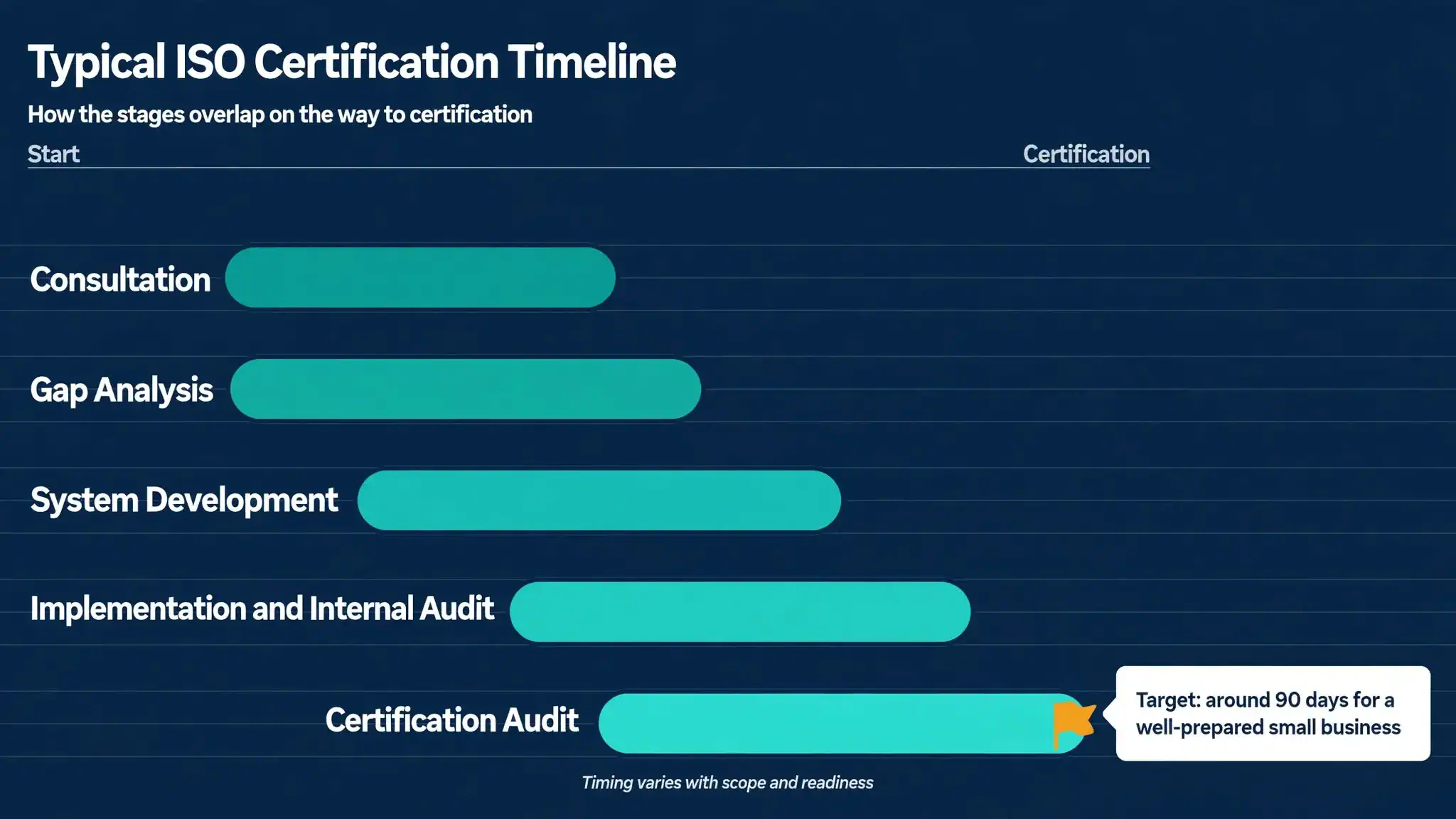
The ISO certification timeline in Sydney depends far more on your starting point than on your postcode. A business with documented processes and a decision-maker who can spare a few hours a week moves quickly. A business where procedures live in people’s heads takes longer, because the system has to be written before it can be tested.
Surecert’s own process is built around certification in 90 days or less, and its money-back guarantee applies if you follow the method and don’t pass your first audit. Treat 90 days as a target for a well-prepared small business, not a promise for every organisation. Three things stretch the timeline most:
- A wide scope, such as several sites or many service lines
- Slow sign-off on documents and decisions inside your business
- Not enough operating records before the certification audit, since auditors need evidence the system has actually been used
Certification bodies usually audit in two stages. Stage 1 reviews your documented system, and Stage 2 checks that you follow it in practice. Once certified, expect annual surveillance audits and a recertification audit every three years.
Which ISO standard fits your Sydney business?
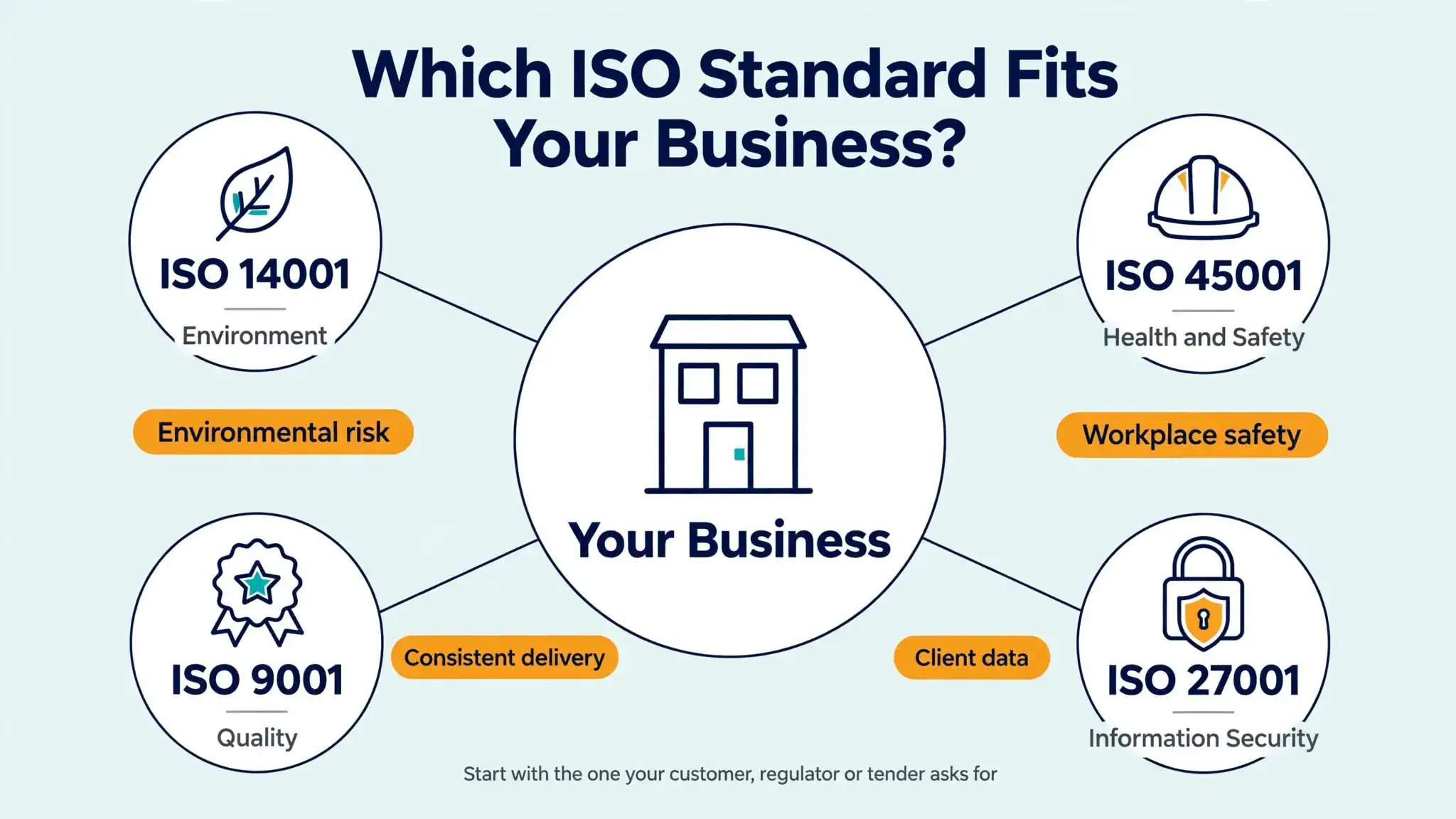
Most businesses don’t need every standard. They need the one a customer, regulator or tender is actually asking for. These four cover most requests from Sydney SMEs:
| Standard | What It Covers | Often Relevant To |
|---|---|---|
| ISO 9001 | Quality management: consistent delivery and continual improvement | Construction, manufacturing, trades, professional services |
| ISO 14001 | Environmental management: managing environmental risks and obligations | Construction, waste, logistics, manufacturing |
| ISO 45001 | Occupational health and safety management | Construction, civil works, high-risk workplaces |
| ISO 27001 | Information security management (2022 edition is current) | IT providers, finance, any business handling client data |
If you’re quoted for ISO 27001, check the edition. The transition deadline from ISO/IEC 27001:2013 to the 2022 edition was 31 October 2025, and SGS reports that 2013 certificates not transitioned by then became invalid. A new certification today should be to the 2022 edition.
For a Sydney construction business, a sensible sequence can be ISO 9001 certification in Sydney first, then ISO 14001 and ISO 45001 as larger clients ask for them. Be clear about what ISO 45001 does and doesn’t do. SafeWork NSW’s guidance on standards says standards are not laws and that conforming to one doesn’t automatically mean you’ve complied with WHS law, though a court may treat it as relevant to meeting your duties. Certification supports your WHS compliance. It doesn’t replace it.
What an ISO 9001 or ISO 27001 audit looks like for a small business

An ISO 9001 audit for a small business in Sydney is smaller and less intimidating than most owners expect. The auditor samples your work rather than inspecting everything. They read your documented system, interview staff about what they do, and ask to see records that prove it: customer complaints, corrective actions, training, supplier checks, internal audit results and a management review.
An ISO 27001 audit follows the same logic for information security. The auditor tests whether you’ve assessed your risks, chosen controls that match them, and can show those controls working. Expect questions on access control, devices, suppliers and incident handling. Small businesses aren’t held to enterprise-scale controls, but the ones you choose must fit your risks and actually operate.
Three habits make audit day easier:
- Staff can explain their own role in the system without a script
- Records are dated, complete and easy to retrieve
- Problems found internally are logged and fixed before the auditor arrives
Auditors don’t expect perfection. A minor non-conformance that you’ve found, recorded and corrected shows the system is working.
ISO certification and NSW government tenders
Many Sydney businesses start the ISO process because a tender asked for it. Procurement documents, including those for NSW government work, often ask suppliers to show they have a quality, safety or environmental management system in place. Some tenders require certification outright, and others score it as evidence of capability. Requirements vary by agency and by contract, so don’t assume one rule fits every opportunity.
Read the tender’s own wording before you commit: which standard is named, whether certification is mandatory or scored, and whether you must hold the certificate when you submit. The NSW Government’s supplier guidance explains how to register and respond to tenders but doesn’t set ISO requirements itself, so the tender documents decide. Certification isn’t always the only route: a NSW Government-sponsored workshop, listed on business.gov.au, covered meeting tender requirements through equivalent quality and WHS processes instead of formal ISO certification. Ask the buyer what evidence they’ll accept. If the closing date is close, tell your consultant early, because a realistic timeline decides whether this tender is achievable.
How to find an ISO consultant in Sydney
Finding an ISO consultant in Sydney is easy. Finding the right one takes a few direct questions. Ask any consultant you’re considering:
- Do you build the system around my business, or adapt a template? Systems built from your actual workflows are easier to maintain and easier to defend in an audit.
- Who does the work, and are they a qualified auditor? A consultant who has audited knows what an auditor will look for.
- What will I have to do, and how many hours a week? Vague answers here usually mean surprises later.
- What’s included in the quote, and what isn’t? Certification body fees are normally separate from consulting fees, so ask for both figures.
- What happens if I don’t pass first time? A clear guarantee tells you how confident they are in their own method.
Be wary of anyone who promises certification regardless of your readiness, or who pushes you toward standards you haven’t been asked for. A good consultant will tell you what you don’t need.
Surecert offers consulting from its North Sydney office. Its lead consultant, Mike Wilson, is a certified ISO auditor with more than a decade of experience helping Australian businesses prepare for certification.
Your next step: a readiness check
Before you commit to a project, find out where you stand. A Sydney business ISO readiness assessment compares the documents and records you already have against the standard and shows what’s missing. Many businesses discover they’re closer than they feared.
Surecert offers a free high-level gap analysis with no obligation: upload your existing documents, fill in the form, and you’ll see what’s in place and what’s missing for certification. You can also request a quote covering costs, time and resources, or call 1300 136 582 to talk it through with a consultant first. Not ready for any of that yet? Surecert also offers a free eBook outlining its roadmap to certification in 90 days or less.
Recent Comments